
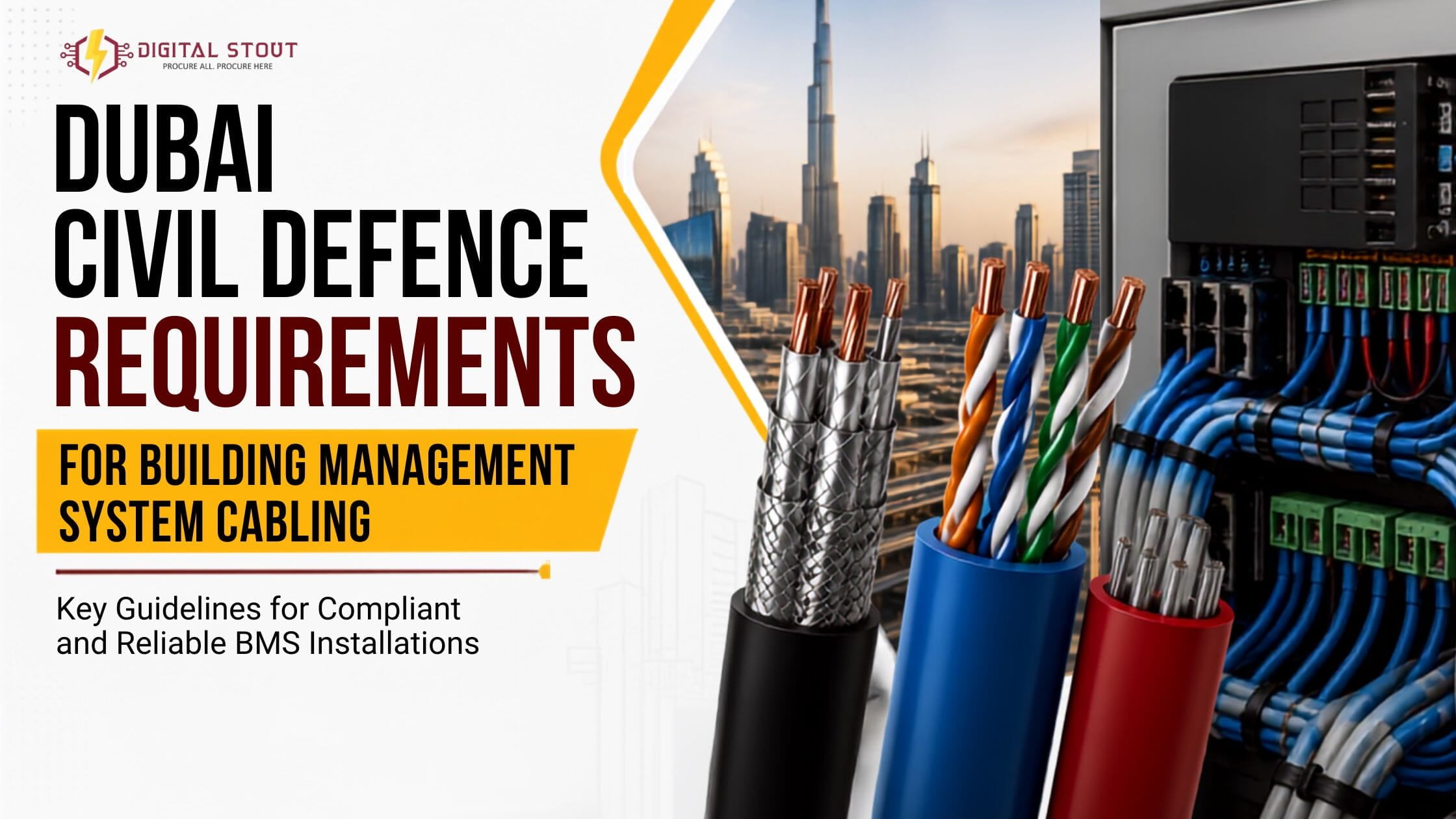
Cabling in Building Management System (BMS) not only allows information transfer from sensors, controllers, and panels in Dubai, but also must be able to withstand fire for sufficient time for a building to react to the event. If any BMS installation involves life safety functions like operation of smoke fans, air-handling units stoppage, or door unlocking, then it becomes subject to DCD electrical safety standards. Incorrect cabling choice not only results in failed test, but also in delays of entire building occupancy permit.
This guide breaks down what DCD actually expects from BMS cabling, in plain terms, so consultants, contractors, and facility managers can specify correctly the first time. If you're sourcing cable for a live project, Digital Stout stocks fire-rated, LSZH, and armoured cable variants across the brands referenced in this guide.
Why BMS Cabling Falls Under Fire Safety Rules
A BMS network isn't purely a comfort system. In most commercial and high-rise buildings, it's wired into the fire and life safety chain triggering AHU shutdowns, releasing electromagnetic door locks, recalling elevators to the ground floor, and activating smoke extraction. Because a BMS cable failure during a fire can disable these functions exactly when they're needed most, DCD treats the cabling for these circuits as a life-safety component, not just a controls component.
That distinction matters for procurement. A cable that performs perfectly under normal conditions but degrades in a fire is non-compliant, regardless of how well it handles data or automation signals day-to-day.
Core DCD Cable Requirements You Need to Know
Fire-Rated Cable for Life-Safety Circuits
For circuits connected to fire alarms, smoke control, and emergencies, DCD demands fire-rated cables which are capable of sustaining their functionality even when there is a fire. It is in contrast to those cables which resist flame propagation but do not remain operational once there is a fire.
A commonly referenced benchmark in UAE fire-rated cable specifications is the CWZ rating, which confirms a cable can:
Maintain circuit integrity for an extended period at extreme temperature (often cited around 3 hours at 950°C in fire-rated cable specifications)
Withstand water spray, simulating exposure to sprinkler systems during a fire event
Survive mechanical shock (z), such as impact from falling debris
Cables used for these circuits are typically tested against recognized standards such as BS EN 50200 and BS 6387, which evaluate fire resistance and circuit integrity under fire conditions. As an example of the category, the Belden 5541FE fire alarm cable a 2-pair, 22 AWG shielded design reflects the kind of specification typically called for on fire alarm interface circuits.
LSZH Sheathing Requirements
Standard PVC-sheathed cable releases dense smoke and acidic gas when it burns both of which are more dangerous to evacuating occupants than the fire itself in many incidents. This is why DCD specifications commonly call for Low Smoke Zero Halogen (LSZH), sometimes referred to as LSF, sheathing on BMS and fire-safety-linked cabling.
LSZH cable UAE specifications matter most in enclosed or high-occupancy spaces plant rooms, basement car parks, riser shafts, and corridors where smoke buildup during an evacuation is a serious risk in its own right.
Physical Protection and Segregation
DCD guidance doesn't stop at the cable itself. Fire-rated BMS and fire-alarm cabling generally needs to run through metallic conduit or fire-rated trunking for mechanical protection, and must be physically segregated from standard power cabling. Running life-safety circuits alongside normal building power in the same containment is a common reason projects get flagged during inspection.
Armoured Cable for Mechanical Protection
In areas prone to physical stress basement plant rooms, external routes, or high-traffic service corridors an armoured cable supplier UAE partner should be able to specify steel wire armoured (SWA) options that combine mechanical protection with the required fire performance. Armouring protects against impact and rodent damage, but it does not substitute for fire rating the two requirements are independent and both may apply to the same run.
How This Applies Specifically to BMS Cable Dubai Projects
Not every BMS cable run needs fire-rated, LSZH, armoured cable. A sensor cable in a non-critical HVAC zone has different requirements than a cable feeding a smoke damper actuator. Browsing the full range of BMS cables available by AWG, core count, and shielding is a useful starting point before finalising a spec. The practical approach is to classify each circuit before specifying:
Life-safety circuits (fire alarm interface, smoke control, emergency shutdown) fire-rated, LSZH, typically in metallic conduit
Critical building operations (chiller plant, elevator controls) often LSZH minimum, sometimes fire-rated depending on the consultant's design intent
Standard automation and monitoring (lighting control, non-critical sensors) standard control or BMS cable, without the fire-rated requirement
Getting this classification wrong in either direction causes problems: over-specifying drives up project cost unnecessarily, while under-specifying risks a failed DCD inspection and rework which is far more expensive than getting it right at the design stage.
Documentation DCD Will Ask For
Civil Defence approval isn't just about installing the right cable — it's about proving it on paper. Expect DCD plan review to require:
Cable fire rating schedules showing which standard each cable type meets
Product data sheets confirming the specified cable matches what's actually installed
Layout drawings showing physical segregation of fire-rated circuits from standard power
A design narrative explaining the compliance approach for the electrical system as a whole
Keeping data sheets and test certificates on file from your supplier at the time of purchase saves significant time when this documentation is requested.
Choosing a Compliant Cable Supplier
Because DCD compliance sits on the supplier's product documentation as much as the installer's workmanship, the supplier matters. When sourcing fire rated cable UAE-wide, or LSZH and armoured cable for a BMS project, look for:
Test certificates referencing recognized standards (BS EN 50200, BS 6387, or equivalent)
Clear labelling of AWG, core count, and shielding on every product listing
Stock availability of both standard and fire-rated variants of the same cable type, so specification changes mid-project don't cause delays
Digital Stout's BMS cable category lists AWG, core count, and shielding on every product, making it easier to match a listing against your project's cable schedule.
Frequently Asked Questions
Does every BMS cable in a building need to be fire-rated?
No. Only circuits connected to life-safety functions fire alarm interfaces, smoke control, emergency shutdown require fire-rated cable. Standard monitoring and automation circuits typically use regular BMS cable.
What's the difference between fire-resistant and fire-retardant cable?
Fire-retardant cable resists flame spread but is not required to keep functioning while burning. Fire-resistant (fire-rated) cable is designed to maintain circuit integrity during a fire, which is the requirement for DCD life-safety circuits.
Is LSZH cable mandatory for all UAE commercial buildings?
LSZH is commonly specified for enclosed and high-occupancy areas due to smoke and toxicity concerns, but exact requirements depend on the building's fire and life safety design, reviewed by DCD at plan approval. Always confirm against the project's approved specification rather than assuming.
Who has final authority on cable specification international standards or DCD?
Dubai Civil Defence's Fire and Life Safety Code takes precedence for any project in Dubai. International standards (BS EN, NFPA) provide the technical testing basis, but DCD's code is the governing document, and its requirements supersede international norms where the two differ.