
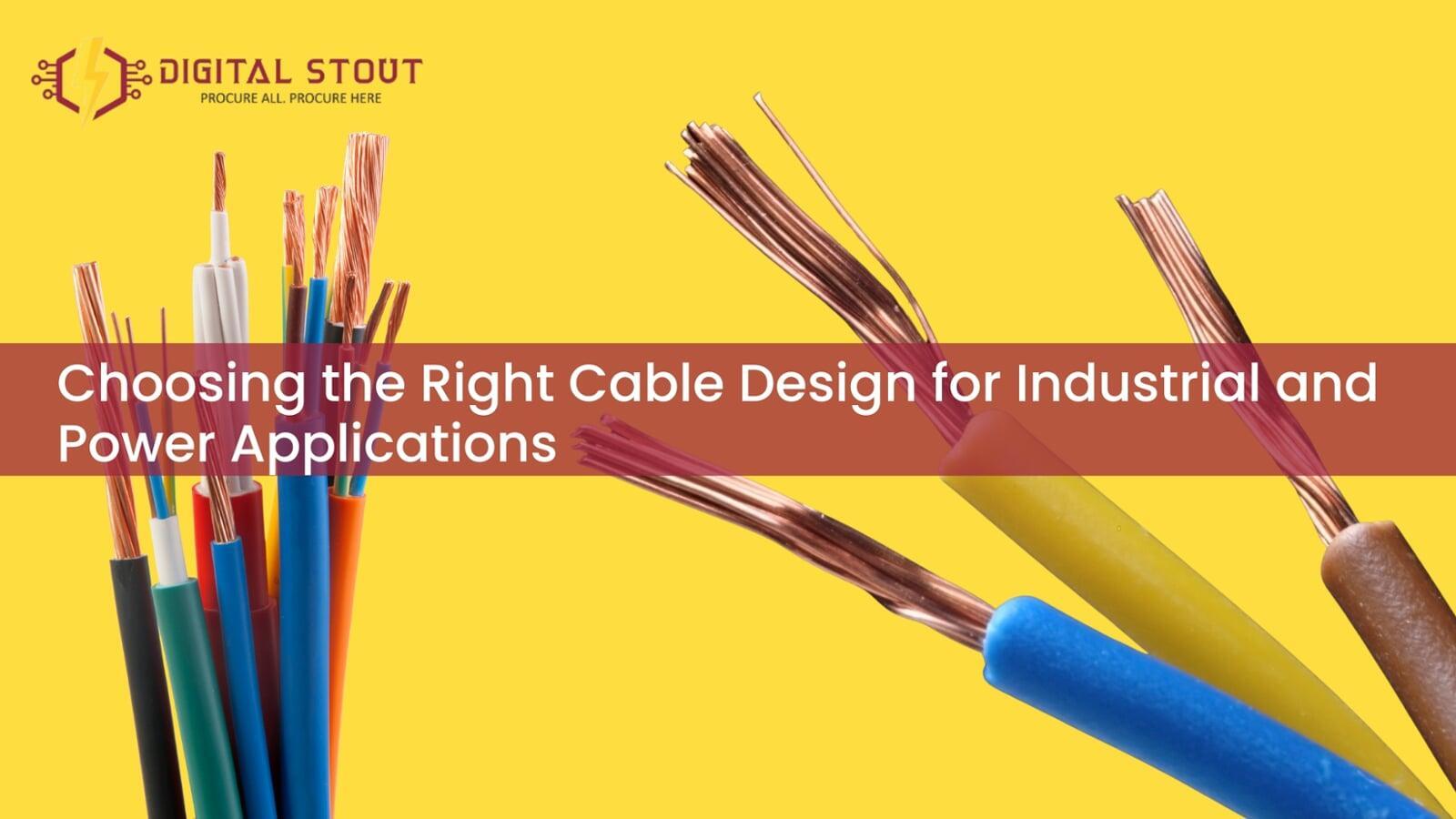
In most cases, when people refer to industrial systems, the emphasis lies in machines, automation, and power tools. However, there is an important, yet ignored factor that plays an integral role in any system, which is cable design. Bad cable design won’t be a problem today, tomorrow, or next week. It will be a problem when least expected.
Cable designs for industrial and power systems experience mechanical stress, vibrations, heat, chemical exposure, and electromagnetic interference every day. Thus, selecting a proper cable is more of a "what will continue working" than "what works" case.
Start With the Reality of Your Application
Before we get to the nitty gritty of specifying the cable, let’s stop for a moment and think about where the cable will be used.
The life of a cable used in a control panel is entirely different from that of a cable that has to perform out in the open on a factory floor or attached to some rotating machinery. It is the common practice among most teams to specify cables based on data sheets only.
What are some practical considerations?
Does the cable need to remain in motion or stationary?
Does the cable come in contact with oil, dirt, or water?
Is it subjected to electromagnetic interference?
Are there any consequences for downtime caused by the cable failing?
Conductor Choice: It’s Not Just Copper vs Aluminum
Most industrial installations favor copper, and there are reasons behind such preference. It exhibits improved conductivity, flexibility, and durability. The choice involves many factors, though.
Copper conductors work best in control circuits, automation, and where flexibility is essential.
Aluminum conductors offer better economic advantage in long-distance electric power transmission lines but should be treated carefully due to low mechanical strength.
Ultimately, the crucial factor is not only the conductor material but also its stranding and flexibility class. Finely stranded conductors demonstrate superior characteristics in applications with motion.
Insulation and Sheathing: Your First Line of Defense
If the conductor is the heart, insulation is the protection layer that keeps everything functioning safely.
Different materials behave very differently under stress:
- PVC (Polyvinyl Chloride)Widely used and cost-effective, but not ideal for extreme temperatures or heavy chemical exposure.
- XLPE (Cross-linked Polyethylene)Handles higher temperatures and electrical stress, making it suitable for power applications.
- Rubber / ElastomersExcellent for flexibility and movement, commonly used in industrial machinery.
In real industrial environments, cables fail more often due to external damage than electrical issues. Abrasion, oil exposure, and mechanical impact can degrade the sheath long before the conductor has a problem.
Environmental Conditions: The Silent Cable Killer
Industrial environments are rarely “normal.” And cables feel that impact more than any other component.
Consider these factors carefully:
- Temperature extremesHigh heat can harden insulation, while cold conditions can make cables brittle.
- Moisture and water exposureEspecially critical in outdoor or underground installations.
- Chemical exposureOils, solvents, and industrial chemicals can degrade standard cable materials.
- UV exposureOutdoor cables without UV resistance will crack over time.
A cable that works perfectly in a lab environment may fail quickly on the factory floor. Matching cable design to environmental stress is non-negotiable.
Movement and Flexibility: Where Most Failures Happen
Static cables are easy. Moving cables are where things get complicated.
In applications like:
Robotics
CNC machines
Conveyor systems
Cables are constantly bending, twisting, or dragging. Standard cables are not designed for this.
You need cables specifically built for:
High flex cycles
Tight bending radius
Torsional movement
A common mistake is using standard cables in dynamic applications to save cost but this often leads to early failure and repeated replacement.
Shielding: When Interference Becomes a Problem
In power-heavy environments, electrical noise is everywhere. Motors, drives, and transformers generate electromagnetic interference (EMI) that can disrupt signals.
If your system involves:
Sensors
Control signals
Communication lines
Then shielding becomes critical.
Use braided or foil shielding for signal integrity
Ensure proper grounding shielding without grounding is ineffective
This is especially important in automation-heavy industries where precision matters.
Load Capacity and Voltage Ratings
This is the more “obvious” part, but still worth mentioning because it’s often miscalculated.
An undersized cable leads to:
Overheating
Voltage drop
Energy inefficiency
But oversizing unnecessarily increases cost and installation complexity.
The key is balancing:
Current carrying capacity
Distance (voltage drop)
Future load expansion
A well-planned system always considers future scalability, not just current requirements.
A Practical Approach to Choosing the Right Cable
Instead of relying only on catalogs, use a practical framework:
Define the application (power, control, data)
Analyze environmental conditions
Determine movement (static vs dynamic)
Select conductor type and flexibility
Choose insulation and sheath based on exposure
Add shielding if interference is present
Validate load and voltage requirements
This approach reduces guesswork and ensures long-term reliability.
Final Thoughts
The choice of cable may appear to be a minor component of the entire assembly, yet its effect is directly proportional to the overall functionality, safety, and maintenance cost of the application. In industrial and power applications, having the correct cable design is imperative, as it affects the efficiency of the whole system.
A well-chosen cable stays unnoticed. A poorly chosen one becomes a recurring problem.
At Digital Stout, we believe that engineering decisions should be practical, informed, and built around real operating environments. Whether it’s system design or component selection, getting the fundamentals right like cable design makes all the difference in long-term success.