
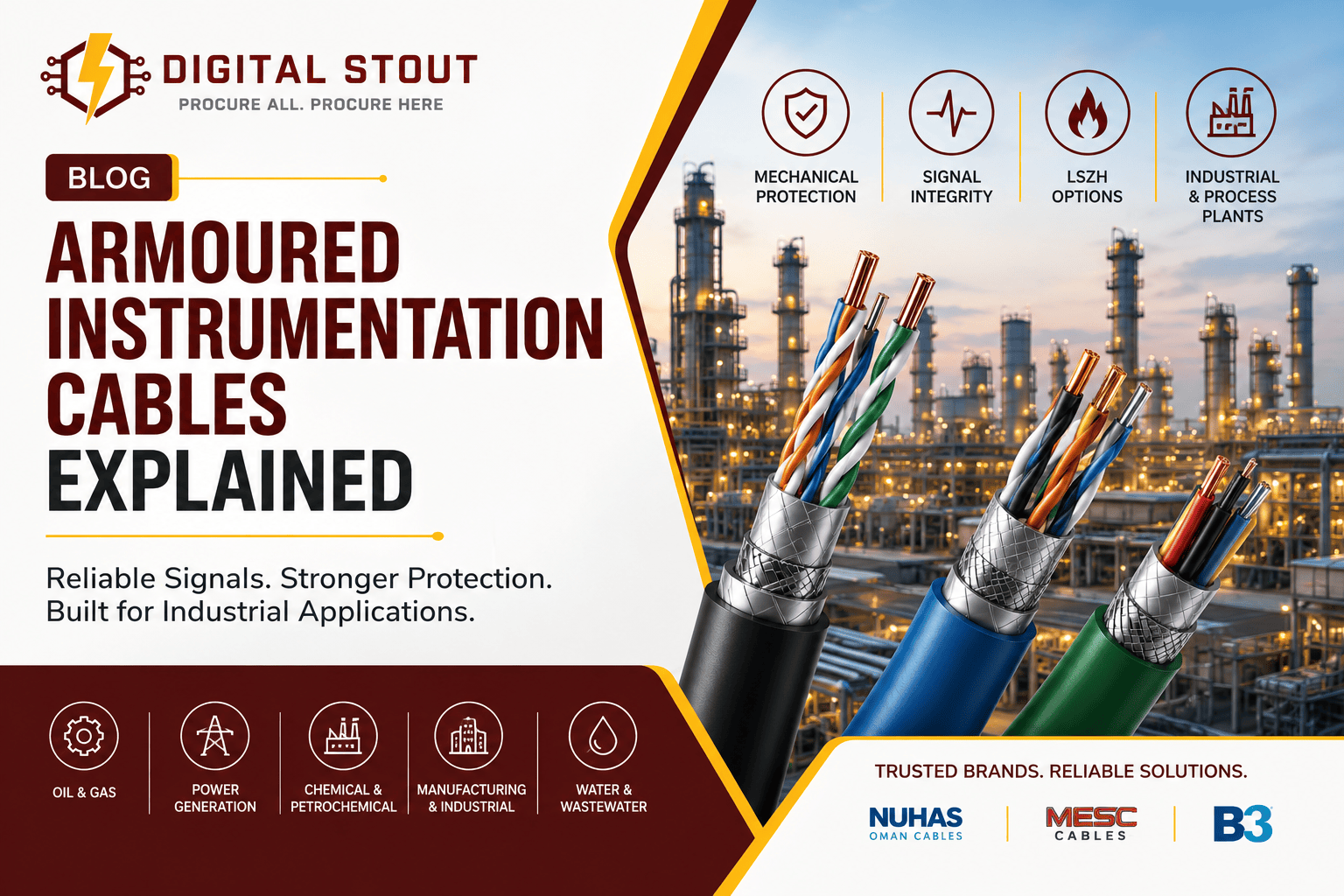
For the effective and safe functioning of industries, communication and signal transmission are of utmost importance. Whether it is the oil and gas industry, power generation, refining industries, chemical industries, manufacturing units, or any other heavy construction projects, the process instrumentation is constantly engaged in transmitting signals through all these processes.
The cable network carrying these signals is equally important as the instruments.
The armoured instrumentation cables UAE are specifically designed for such applications where there is a need for reliability of signals along with increased protection of cables. As opposed to ordinary instrumentation cables, the armoured cables provide additional protection to the cables.
In this article, we will discuss what are armoured instrumentation cables, their application, importance of armouring, and how to choose the right cable for industrial applications.
What Is an Armoured Instrumentation Cable?
Instrumentation cable is an electric cable intended for transmission of low level signals from instruments for control, monitoring, measurement and communication purposes. The source of the signals may be any field devices like thermometers, pressure transmitters, flowmeters, level indicators or other monitoring devices.
Armored instrumentation cable contains an extra armor layer of protection in addition to the basic cable construction. It assists in offering additional protection against mechanical damage when used in harsh conditions.
The construction of this cable will depend on the manufacturer and specific project requirements. A typical cable construction may include insulated conductors, twisted pairs/triples, shielding if necessary, bedding material, armor and outer jacket.
This is why armored instrumentation cables can be used in harsh industrial settings.
Why Is Armour Important in Industrial Cable Applications?
Industrial cables are often installed in environments where ordinary communication or control cables may be exposed to mechanical risks.
For example, cables may be routed through industrial plants, cable trays, outdoor areas, underground routes, process facilities, and equipment zones. During installation and throughout the operational life of a facility, cables can potentially be exposed to impact, compression, accidental damage, and harsh environmental conditions.
The armour layer provides an additional level of protection to the cable construction.
This does not mean that every instrumentation cable requires armour. The correct cable should always be selected according to the installation environment and project requirements. However, where mechanical protection is important, an armoured design can provide a more robust solution.
For major industrial projects, selecting the correct armoured instrumentation cable UAE product can help support long-term reliability and reduce the risk of cable damage.
Where Are Armoured Instrumentation Cables Used?
Armoured instrumentation cables are commonly associated with industrial environments where reliable signal transmission and physical protection are both important.
Oil and gas facilities are one of the major application areas. Refineries, processing plants, offshore and onshore facilities, and pipeline infrastructure use numerous instruments to monitor pressure, temperature, flow, and process conditions. These instruments need reliable connections to control and monitoring systems.
Power generation facilities also use extensive instrumentation networks. Signals from equipment and monitoring devices must travel between field locations and centralized control systems.
Chemical and petrochemical plants, water treatment facilities, manufacturing sites, cement plants, mining operations, and other industrial environments may also require instrumentation cables suitable for demanding conditions.
In each case, the cable selection should be based on the actual installation requirements rather than simply choosing an armoured cable as a standard solution.
Understanding the Role of Instrumentation Cables
The instrumentation cable differs from the traditional power cables since it is designed primarily for signal transmission instead of the distribution of electric power.
The cable is able to transmit low voltage signals from instruments to the control room, DCS, PLC, and any other automation equipment.
In addition, reliable signal transmission is crucial for an industrial environment where incorrect data can interfere with process monitoring and decision-making.
Therefore, the design of an instrumentation cable can include elements that may facilitate dealing with electrical noise and signal integrity.
Based on the specific purpose of the cable, its structure may include twisted pairs, shielding of individual conductors, shielding of the entire assembly of conductors, among other special constructions.
Thus, an industrial signal cable should be selected taking into account not only its electrical characteristics but also the conditions of its installation.
Armoured vs Unarmoured Instrumentation Cable
The main distinction between the use of armoured or unarmoured instrumentation cables lies in the degree of mechanical protection afforded by the cable design.
Unarmoured cables might be adequate for installation in a protected environment, such as control rooms, cabinets and where no substantial mechanical hazards will occur to the cable.
Armoured cables are typically selected where additional mechanical protection is needed. Such installations might be made in industries, outdoors, in trenches or any location where there could be mechanical risk from the cable, as defined by the design of the project.
However, armouring the cable should not be chosen simply because it seems more robust.
The addition of an armoured layer will impact the weight, installation of the cable, its flexibility and overall cost of the project.
The right choice would be the one that will provide the needed protection but at the same time take into account the real conditions of installation.
The Importance of Shielding in Instrumentation Cables
There are many possible sources of electromagnetic interference within an industrial setting. These include motors, transformers, inverters, generators, power cables, and electrical components.
These signals can be prone to such interference.
The instrumentation cable itself can have shielding features added in order to reduce the effects of this interference.
There are different forms of shielding that can be used. There may be shielding around the pairs of wires or groups of wires, or there could be shielding over the entire wire depending on the application and specifications.
What is important here is that the need for shielding depends on the application of the signal and its environment.
Just picking the cable with the most shielding is not necessarily the best option. Other aspects like cable placement, separation from power circuits, and installation are important factors.
What Is LSZH Armoured Cable?
Fire safety is another important consideration when selecting industrial cables.
An LSZH armoured cable uses a Low Smoke Zero Halogen sheath material designed to reduce the release of halogen gases and limit smoke generation under fire conditions compared with conventional halogen-containing cable materials.
LSZH cable constructions are often considered for projects where fire safety and smoke performance are important requirements.
This can be particularly relevant in enclosed industrial facilities, commercial infrastructure, transportation environments, public buildings, offshore installations, and other locations where project specifications require low-smoke and halogen-free cable solutions.
However, LSZH requirements should always be checked against the project specification and applicable standards. Not every industrial installation requires the same sheath material.
The selection should consider the complete operating environment, including fire requirements, temperature, chemical exposure, UV exposure, moisture, and mechanical protection.
Nuhas Oman Cables for Industrial Applications
When sourcing instrumentation cables for projects in the Middle East, manufacturers with experience in industrial and regional infrastructure projects can be an important consideration.
Nuhas Oman cables are associated with cable solutions for industrial and infrastructure applications in the region. When selecting a specific cable product, however, buyers should always verify the exact product construction, technical datasheet, standards compliance, conductor configuration, shielding arrangement, armour type, and sheath material.
It is important not to purchase instrumentation cable based only on the manufacturer name.
Different manufacturers can produce multiple instrumentation cable configurations for different applications. The exact product reference and approved technical specification should always be reviewed before procurement.
For project buyers, working with knowledgeable instrumentation cable suppliers UAE can make it easier to identify the correct product based on the consultant specification and application requirements.
MESC Instrumentation Cable and Project Specifications
Many industrial projects specify cables according to recognized manufacturer standards, project requirements, or established industry specifications.
A MESC instrumentation cable may be requested for projects where a particular MESC specification or approved cable construction is required.
When dealing with specification-based procurement, buyers should carefully compare the requested requirements with the proposed product datasheet.
Important factors can include conductor size, number of pairs, insulation material, shielding configuration, armour type, outer sheath material, voltage rating, temperature rating, and applicable standards.
Equivalent products should not be assumed to be identical without technical verification.
A professional procurement process should involve reviewing the technical documentation and confirming that the proposed cable meets the requirements of the approved project specification.
Common Applications for Armoured Instrumentation Cables
Industrial instrumentation cables are widely used in industrial applications since instrumentations are critical components in process control and automation systems.
Oil and gas processing units have instrumentation systems that link field instruments with control and monitoring equipment. Such installations may require significant cable runs through large, difficult locations.
In power plants, instrumentation cables can be utilized in monitoring and control systems for generating systems, turbines, auxiliary systems, and plant systems.
The petrochemical and chemical processing units require efficient process monitoring, and hence signal transmission is an integral part of the infrastructure.
In water and wastewater treatment facilities, there are instruments and automated control systems that allow the monitoring of flow, pressure, chemical treatments, and operation of equipment.
In manufacturing plants, automation and data collection are becoming increasingly common, thus the need for signal and control infrastructures.
Despite the different needs in the above industries, there is a common requirement for reliable communication between field instruments and control systems.
Choosing the Right Armoured Instrumentation Cable
Selecting the correct cable begins with understanding the application.
The first consideration should be the type of signal being transmitted and the requirements of the connected instrumentation system. The number of conductors or pairs required should then be determined according to the system design.
The installation environment is equally important. A cable installed inside a protected control room may have very different requirements from one routed through an outdoor industrial facility or a mechanically demanding plant environment.
Project teams should also consider whether shielding is required to manage electromagnetic interference. The proximity of power equipment, motors, drives, and other electrical infrastructure can influence this decision.
Fire performance and sheath material should also be reviewed. Where required by the project specification, an LSZH armoured cable or another specialized cable construction may be appropriate.
Finally, the cable should be checked against the consultant-approved specification and manufacturer documentation before purchase.
Why Choosing the Right Instrumentation Cable Supplier Matters
Industrial projects often require large quantities of cable with specific technical requirements. Selecting a reliable instrumentation cable suppliers UAE partner can help procurement teams manage this process more effectively.
A knowledgeable supplier should be able to provide accurate product information and technical documentation rather than simply supplying a cable with a similar name.
Product traceability and authenticity are also important, particularly when projects require branded products or specific manufacturer approvals.
Availability can be another major consideration. Delays in cable supply can affect installation schedules and project commissioning.
A supplier with access to different manufacturers and cable constructions can also help procurement teams compare options when a project requires armoured, shielded, LSZH, or specification-specific instrumentation cables.
Common Mistakes When Selecting Instrumentation Cables
Selecting cables without considering the type of shielding, insulation, armour and environmental properties even when they have the same conductor count is another common error.
Selecting cables without taking into consideration the installation environment is another common error. For example, a cable that is fit for an indoor environment will probably fail if installed in an outdoor industrial environment.
There is also the case where the project team makes errors regarding the installation of shielding. It is imperative to note that the shielding is not selected by default but is selected depending on the type of signals used and the electrical environment.
In some cases, project teams tend to make procurement errors without consulting the exact project specifications. The name of the manufacturer does not guarantee conformity, but one needs to check the product reference and datasheets.
Lastly, it is imperative to note that cable installation should not be overlooked. Inefficient installation of the cable will lead to poor performance even when it is a good cable.
The Future of Industrial Signal Cabling
Industry plants are moving towards automation and interconnectedness.
The modern industrial plants have started generating a large amount of information from their field instruments, sensors, controllers, and monitoring systems. With the increasing use of industrial automation, the importance of the physical infrastructure that will be used for the transmission of signals will increase.
Even though there has been development in the field of wireless technology and industrial networking, the physical cables are still necessary for many critical industrial installations.
The use of instrumentation cabling is necessary to form the physical link between the field level devices and the control and monitoring systems of the industrial process.
Conclusion
Armoured instrumentation cable UAE solutions are created for industrial applications which require both reliable signal transmission and some mechanical protection to the cable.
Such cables can become vital elements in oil and gas facilities, power plants, refineries, chemical plants, manufacturing facilities, and other challenging industrial locations.
It is important to emphasize that a decision about choosing the right cable cannot be made only based on the armour. It is also necessary to consider other aspects like the nature of the signal, the shielding of the cable, the installation environment, fire resistance, sheathing materials, and specific project requirements.
In some cases, the project may require an industrial signal cable, LSZH armoured cable, specification-compliant MESC instrumentation cable, or cables from such manufacturers as Nuhas Oman cables.
In any case, the choice of the product must always be confirmed by its technical datasheet and project requirements.
For engineers, contractors, consultants, and purchasing departments, cooperation with experienced instrumentation cable suppliers UAE can make sure that the right cable will be chosen for a particular application.